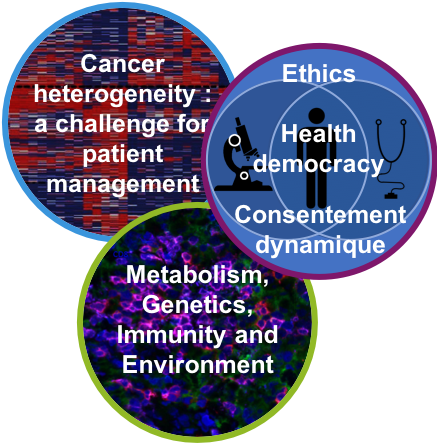
The first challenge is to integrate metabolism in its broad sense, ranging from risk factors related to the lifestyle (physical inactivity, obesity, eating habits…) to molecular mechanisms induced in tumor cells or immune cells, with cell-intrinsic and immunosurveillance-related mechanisms of carcinogenesis. The ultimate outcome of this challenge is to define (i) preventive behaviors based on proven molecular knowledge, (ii) new therapeutic targets and (iii) new prognostic or predictive markers.
The second challenge consists in the comprehensive study of tumor heterogenity which plays an important role in cancer treatment resistance and constitutes the next frontier for developing an effective precision medicine. The in-depth comprehension of heterogeneity at intra- or inter-tumor levels will allow us to identify new composite biomarkers and therapeutic strategies to delay resistance to treatment.
The third challenge is the integration and sharing of data generated on a large scale by the technical advances implemented in both research and healthcare. This essential step requires the adherence of patients and volunteers involved in observational and interventional research programs. It requires the development of modern tools that use the most advanced information technologies to collect and integrate data. In particular, we will implement dynamic consent, which will allow us to respond to the ethical and societal questions raised by the increasingly porous border between care and research. The use of information collected within the framework of medical care and used for research is more frequent and essential for the improvement of patient treatments.
Through 3 integrated research programs, we want to provide solutions that will improve the patients prognosis by better defining their disease, by identifying new therapeutic targets, by preventing relapse and improving quality of life through a reasoned change in lifestyle, by fostering the adherence of society to changes related to technological advances and by making patients active players in cancer research. Thanks to their outstanding expertise in basic, translational and clinical research, CARPEM teams will be able to meet these challenges.
Our achievements are available >>here<<




 Acute Myeloid Leukemia: identification of a new targeted therapy approachApril 14, 2022Acute myeloid leukemia (AML) is a hematologic malignancy that develops from hematopoietic stem Read more »
 [SIRIC CURAMUS] COVID and Cancer Workshop on April 5, 2022March 28, 2022SiRIC Curamus is hosting a COVID & Cancer workshop on Tuesday, April 5, 2022 to discuss Read more »